Lab
Machine Learning for Quantitative Finance
E-Textbook







Lab - What's new
Can one explain the mathematics of machine learning both easily and in depth?
Published March 18, 2026
Yes, with the "Mean-Covariance" approach
Unlike the Probabilistic approach (opens in a new tab) , the Mean-Covariance approach (opens in a new tab) restricts the modeling of randomness strictly to expected values and covariance matrices, using linear algebra to build robust, closed-form models.
With the Mean-Covariance approach we can immediately understand in depth all advanced machine learning concepts, without foregoing an ounce of mathematical formalism and rigor.
Core Principles of the Mean-Covariance approach
- Focus on the first two moments (opens in a new tab) : Instead of modeling the full probability density function of financial risk factors, the Mean-Covariance framework summarizes uncertainty entirely through the mean vector and the covariance matrix.
- Linear operators (opens in a new tab) : The Mean-Covariance approach strictly utilizes linear transformations. Projecting risk factors to the investment horizon, mapping instruments to those factors, and aggregating asset returns into a portfolio return are all treated as linear combinations.
-
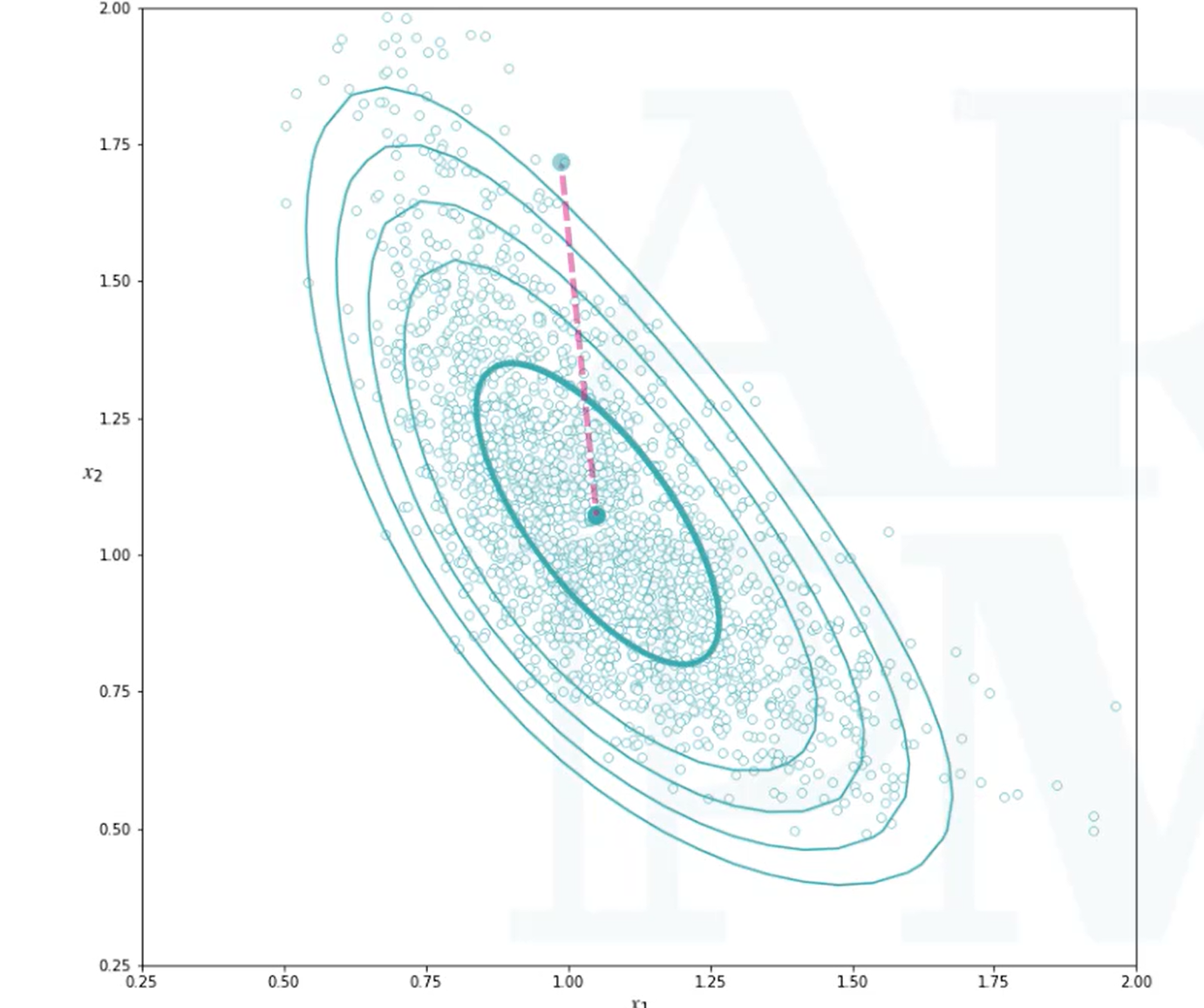
Non normality: The Mean-Covariance approach is not
restricted to normal distributions. Rather, it applies across all distributions (skewed,
multi-modal, mixed, discrete,...). Below is an example with a log-normal.
Obvious benefits of the LMC Approach
- Analytical Tractability: Because linear transformations of means and covariances follow straightforward algebraic rules, this framework guarantees computationally efficient, exact solutions. It avoids the heavy computational burden of Monte Carlo simulations or numerical integration.
- Estimation: By ignoring higher-order moments, Mean-Covariance models are generally less prone to estimation error, making them highly practical in financial applications.
Hidden benefits of the LMC Approach
- Mean-covariance= Probabilistic (opens in a new tab) : using the one-hot encoding, any probabilistic model, no matter how complex, can be modeled in the Mean-Covariance framework.
- Advanced econometrics (opens in a new tab) : all the techniques such as spectral theory, Wold representation, filtering and convolution, followed by applying the Mean-Covariance framework to the deterministic trend and the autocovariance function.
- Causal graphical structures (opens in a new tab) : partial uncorrelation induces the same set of causal structural relationships as conditional independence, in the tractable language of structural equations models.
- Higher moments: The most subtle features, such as tail dependence or higher moments, are best addressed by a Probabilistic model after a first pass of dimensions reduction in the Mean-Covariance framework.
Examples
Examples of advanced models that have a simple counterpart include:
- probabilistic graphical models
- probabilistic autoencoders
- diffusion models
- generative models
- optimal transport
- …and many more
For instance, Causal Bayesian networks are probabilistic graphical models built on complex conditional independence relationships.
The mean covariance counterpart of “conditional independence” is “partial uncorrelation (opens in a new tab) ”, which reads simply as follows: X is partially uncorrelated with respect to Z if the residual of a regression of X on Z has uncorrelated entries.
To learn more
Read: The Mean-Covariance vs Probabilistic Ecosystem of Machine Learning (opens in a new tab)